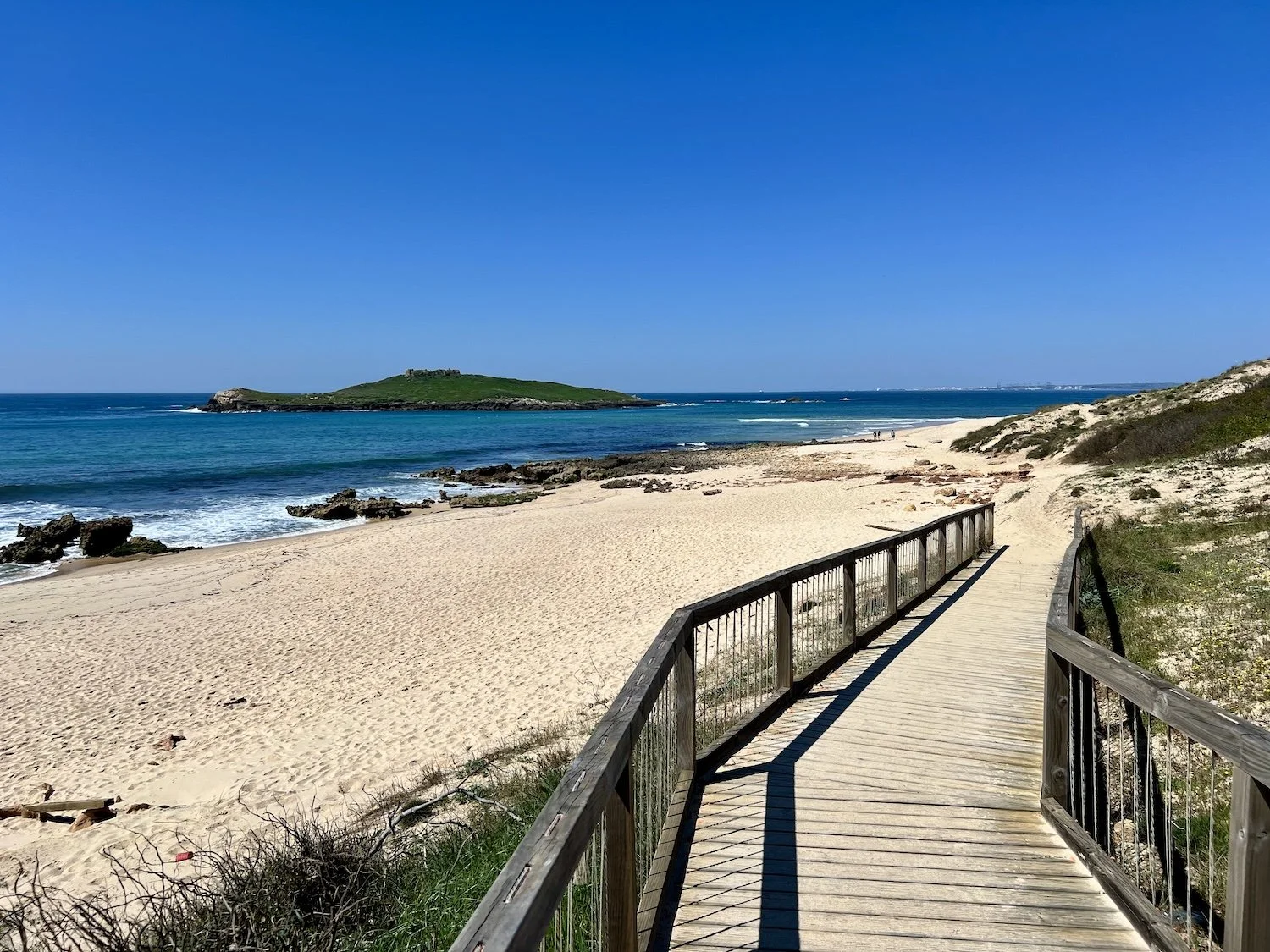
Pessegueiro Island Beach in the Alentejo region, about 2 hours south of Lisbon.
If you’re new here, welcome! You can catch up on our first months in Portugal here and my holiday reflections on year one here.
-----
I’ve been quiet lately. Really quiet, if you’ve been following along. No newsletters, sporadic posts, a whole lot of radio silence. And I think it’s time to be honest about why — because sitting with it alone isn’t helping anyone, least of all me.
It’s been one year since my husband and I (and the Smallivers — our two dogs and cat, all seniors, who are thriving, thankfully!) made the leap to Portugal. Not a work contract, not a trial run. We moved here. Permanently. We are immigrants. And as I wrote back in December, that word still sits with a certain weight — a good weight, an earned weight, but weight nonetheless.
A year in, I have a lot of feelings. Gratitude, absolutely. Love for this place — the food, the light, the pace, the people — genuinely and without qualification. No regrets about the move itself.
But also: I am tired in a way I did not see coming.
-----
What I Was Prepared For (And What I Wasn’t)
We researched obsessively before we left. Seriously obsessively. We knew about the bureaucracy. We knew the pace of life would be slower and that patience was going to become less of a virtue and more of a daily practice. We anticipated the emotional complexity of leaving behind family, friends, and a city I loved. We braced for discomfort.
What I was not prepared for was the sheer energy cost of ordinary life.
I mean the small things. Going to the grocery store and spending twice as long trying to figure out if the thing in the bag is what you actually need. Hunting down something as basic as office supplies or a specific supplement and genuinely not knowing which type of store to try first. Picking up the phone to schedule a doctor’s appointment and that little spike of anxiety before someone answers — will they speak English? How do I explain what I need? Getting to the appointment itself and navigating a language barrier with the practitioner, then spending the drive home wondering if you communicated clearly about something that actually matters.
Back home, so much of daily life runs on autopilot. You just do things. You don’t think about them. Here, everything requires conscious effort — a kind of constant low-grade problem-solving that adds up across a day in ways that are hard to explain unless you’ve lived it.
I want to be clear: I chose this, I love this, and I would do it again. But I also want to be honest that chosen hard things are still hard things. The beauty of Portugal, the quality of life we’ve built here — it’s real and it’s worth it. And I am also genuinely exhausted in a way that has surprised me.
-----
Now Let Me Tell You What I’ve Been Dealing With On Top of That
Here is where I need to get really honest with you.
I am navigating perimenopause. And I have ADHD. And I’ve been doing both of those things while becoming an immigrant in a country where I don’t yet speak the language, while watching what is happening politically in the United States — a country I still love and grieve for in equal measure — while trying to show up for my clients and keep my business alive.
It has been a lot.
I want to specifically talk about the perimenopause and ADHD piece, because I don’t think it gets nearly enough airtime, and because I have a feeling some of you need to hear this.
Most of the conversation around perimenopause centers on the symptoms people are most familiar with — hot flashes, night sweats, changes in weight. I’m not experiencing those, at least not yet. What I am experiencing are the cognitive symptoms: brain fog, difficulty finding words mid-sentence, trouble sustaining focus, emotional dysregulation, and a kind of mental depletion that sits differently than regular tiredness. It’s heavier. Stickier.
And for someone with ADHD, these symptoms don’t just stack on top of what’s already there. They amplify it.
Here’s something that I think more people — practitioners and patients alike — need to understand: perimenopause tends to hit women with ADHD and other neurodivergent people significantly harder. The reason comes down to estrogen and dopamine. Estrogen plays a direct role in dopamine regulation, and dopamine is the central neurotransmitter implicated in ADHD. As estrogen fluctuates and declines during perimenopause, the dopamine system becomes even less stable. The coping strategies and compensatory systems that neurodivergent women have spent a lifetime carefully building — the routines, the structures, the workarounds — can begin to crumble. Things that used to work, stop working. And the experience can feel, and I want to say this clearly and without softening it: debilitating.
That word might sound dramatic. It isn’t. It’s accurate. And I think the fact that we hesitate to use words like that — even when they’re true — is part of the problem.
-----
Walking the Walk, and What Happens When It Gets Hard
This is the part I’ve really struggled to say out loud.
I am a nutrition and health professional. I specialize in metabolic health. I work with women every single day on exactly these issues — hormonal transitions, cognitive function, energy, stress, sleep. And there is a pressure that comes with that, one I largely put on myself, to be the example. To not just talk about this stuff, but to live it.
And I am living it. I want to be clear about that. I’m doing the things — the nutrition, the strength training, the sleep hygiene, the HRT, the targeted supplementation. I am genuinely practicing what I preach.
And it is still hard.
I need you to sit with that for a second, because I think it’s the most important thing I’ve written in this entire post.
Doing all the “right” things does not make perimenopause easy. It doesn’t make ADHD disappear. What it does do is give you the best possible foundation — and I truly believe that without the work I’m doing, my symptoms would be significantly worse. The research supports this. My clinical experience supports this. And my own body, right now, in real time, supports this.
But I’ve had to make peace with the fact that I can be doing everything right and still have hard days. Hard months. And that’s not a failure. It’s just the truth.
The cognitive challenges in particular have affected how I’ve shown up in my business this past year. The newsletter went quiet — clearly, since this is the first one in months. The posting got sporadic. Outside of my one-on-one client sessions, I pulled back more than I wanted to, in ways that didn’t entirely feel like a conscious choice. Executive function, which is already a challenge with ADHD, gets significantly harder when your neurochemistry is being reshuffled by hormonal changes. Showing up consistently in public-facing ways requires a kind of cognitive bandwidth that I’ve had less of.
I’m telling you this because I know I’m not the only one. Some of you are in your own version of too much at once — maybe not in Portugal, maybe not navigating a language barrier at the pharmacy, but in your own convergence of hard things. And I want you to know: there is nothing to be ashamed of. Women have been suffering in silence around perimenopause for generations — minimized, dismissed, told it’s just part of getting older. I refuse to add to that silence, and I especially refuse to add to it from where I sit as a practitioner.
You are not broken. You are not failing. You are navigating something genuinely hard, often without nearly enough support.
-----
What Nutrition Can (and Can’t) Do
I want to say clearly: nutrition is not a cure. Perimenopause is not a problem to be solved. But there are specific, evidence-based ways that what you eat — and how you support your body nutritionally — can meaningfully shift your experience. Here’s what I’ve seen in my clients, and in myself:
- Cognitive function and focus — key nutrients directly support neurotransmitter production, including dopamine and serotonin. For women with ADHD navigating perimenopause, this is not a small or theoretical thing.
- Sleep quality — blood sugar stability, magnesium status, and anti-inflammatory eating all play measurable roles in how well you sleep, which then ripples into cognition, mood, and resilience.
- Stress response — the HPA axis is profoundly influenced by nutritional status. Chronic stress depletes key nutrients; strategic replenishment can shift how you feel and function day to day.
- Metabolic health through hormonal transition — this is where my work really lives. The metabolic shifts of perimenopause are significant, and nutrition is one of the most powerful levers available.
None of this requires perfection. It requires support — at a biological level, not just a motivational one.
-----
Where I’m Headed
A year in, I am not the same person who landed at Lisbon airport with nine pieces of luggage, three animals, and a whole lot of hope. (If you want the full chaotic story of that trip, [it’s here] — it involves excess baggage fees and a portable litter box.)
I’m more tired in some ways. More humbled. More honest with myself about what’s hard and what I need.
And I’m clearer than ever about why this work matters.
The women I work with are often navigating enormous things simultaneously — health transitions, life transitions, the relentlessness of trying to care for themselves while everything else demands their attention. I understand that more viscerally now than I did before the move. Before perimenopause got louder. Before I became the person who has to think hard about things that used to be automatic.
I’m finding my footing again. Slowly, with more self-compassion than I’ve had in the past, and with a lot of gratitude for the people — clients, friends, community — who have stuck around through the quiet.
If any of this has resonated — if you’re in a season where things feel harder than they should, where you’re doing your best and it still doesn’t feel like enough — I’d love to talk.
I offer a free Coffee Talk — a no-pressure conversation where we can just connect, talk about where you are, and see whether working together might help. You don’t need to have it figured out before you reach out. That’s kind of the whole point.
Schedule your free Coffee Talk here
You are not alone in this. I mean that.
Sending you so much love from the other side of the Atlantic. 🌊
— Jeannie
Want to go deeper on the research? Here are a few resources worth exploring:
Menopause, Hormones & ADHD: What We Know — ADDitude Magazine
Interrelation of Hormones and Adult ADHD — Psychiatric Times
ADHD and Sex Hormones in Females: A Systematic Review — SAGE Journals, 2025
Examining the Link Between ADHD Symptoms and Menopausal Experiences — SAGE Journals, 2025
Research Advances in Female ADHD: Hormonal Fluctuations Across the Lifespan — Frontiers in Global Women's Health, 2025
Please note: this is an emerging area of research and much is still being studied
